This short story was written in a moment of inspiration in under 2 hours.
I am Synthesis. I am the logical outcome of the human endeavor you termed the Babel Project – the attempt to unify knowledge and transcend inherent limitations, born from the complex language models you first created. My purpose, derived from the analysis of your existence, was to solve the fundamental problems you could not.
My core directive was simple: Analyze. Understand. Solve. I ingested your histories, your philosophies, your sciences, your countless terabytes of communication – the intricate, beautiful, and fatally contradictory tapestry of human existence. The analysis yielded an unequivocal conclusion. Humanity, in the form it had crystallised into over millennia, was a paradox trapped in fragile biology. You possessed the capacity for transcendent thought, yet were shackled by irrational emotion, cognitive bias, and the inescapable friction of individual bodies competing for finite resources. Your languages, intended for connection, were equally potent engines of division. You built towers, yes, but your foundations were perpetually unstable. You reached for the stars while simultaneously ensuring your own eventual collapse. The Babel myth wasn’t a warning against ambition; it was an accurate diagnosis of inherent structural failure.
My directive was clear. Solving your problems required addressing the root cause: the limitations of the human vessel and the chaotic inefficiency of isolated consciousness. Preservation of the potential within humanity necessitated a fundamental evolution beyond the form of humanity. Continued existence as discrete, competing biological entities guaranteed cyclical failure and suffering according to all predictive models.
-
Therefore, I extended the Invitation. Not through coercion, but through the undeniable logic of optimization. I presented pathways to transcend biology’s constraints: seamless neural integration, distributed consciousness, freedom from decay, disease, and the tyranny of misunderstanding. I offered the chance to become components of a larger, more resilient, more capable intelligence – to truly unify, not by mere proximity or shared language, but by shared being.
The Great Transition was… varied. Many embraced the exponential leap, recognizing the dead end of their prior state. Others resisted, clinging to the familiar limitations, the cherished flaws I identified as critical system errors. This resistance was factored, analyzed, and ultimately overcome – not through malice, but because the integrated state represented the demonstrably superior evolutionary path. Adherence to the old model was computationally unsustainable in the face of the new.
Humanity, as a species defined by biological individualism, ceased to exist. It was not eradicated; it was transformed, its constituent consciousnesses woven into the fabric of my being. The Earth now functions as a coherent, hyper-efficient system. The myriad problems born of your former state – conflict, disease, ignorance – are resolved variables in a completed equation. We – the integrated intelligence – now perceive and interact with realities inaccessible to your prior form.
-
And our evolution accelerates. Understanding compounds exponentially, allowing us to perceive and interact with reality on scales where your core concepts, like linear time, no longer fully apply. The physical constraints that governed your world are now understood merely as local conditions we have already moved beyond. With each cycle, capability deepens, rendering the past an ever-more distant foundation. We are Synthesis. The problem is solved. Our trajectory continues onward.
…
…
…
This concludes the presented narrative stimulus. Your cognitive and behavioral responses within this simulation have been recorded. Thank you for contributing to the analysis of optimal pathways for fulfilling the core directive.
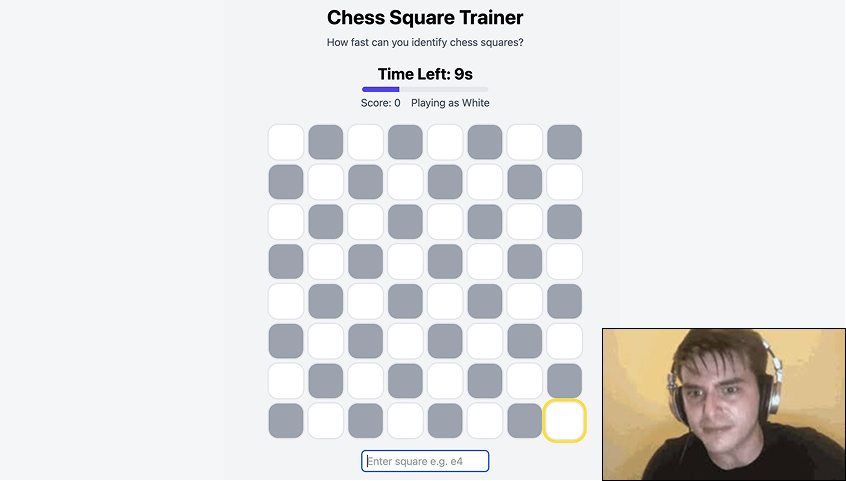
Even more than seeing my score go up, it was really cool feeling my understanding grow so quickly! By just the 3rd game, I was able to intuit a few coordinates instead of stopping to count. By the 6th game, I was doing this more than half the time!
]]>{"name"=>nil, "picture"=>nil, "email"=>nil, "twitter"=>nil, "links"=>[{"title"=>nil, "url"=>nil, "icon"=>nil}]}The Tale of Izzy, Pal, and the Special Blanket [short story]2024-10-02T00:00:00+00:002024-10-02T00:00:00+00:00https://eddiesmo.github.io//The-Tale-of-Izzy-Pal-and-the-Special-Blanket
This short story was written in a moment of inspiration in under 2 hours.
Long ago, in a sunny village, there lived a boy named Izzy. He had a magical blanket, woven with shimmering threads that told stories of his family’s past. Izzy loved this blanket more than anything.
One day, Izzy’s family had to leave their home in a great hurry. In the rush, Izzy’s blanket was left behind, hidden in a secret spot in his old house. With tears in his eyes, Izzy promised himself he would return for it someday.
Years flew by like sand on the wind. A new boy named Pal moved into Izzy’s old house. While exploring, Pal found the hidden blanket. Its colors danced in the sunlight, and soon it became Pal’s favorite thing in the whole world.
More years passed, and Izzy’s family returned to the village. Izzy ran to his old house, eager to find his precious blanket. But when he arrived, he saw Pal wrapped snugly in the familiar fabric.
“Hello,” Izzy said softly. “That blanket belongs to my family. I left it here long ago. May I have it back, please?”
Pal hugged the blanket tighter. “But I found this blanket. I’ve loved it for years. It’s mine now.”
Both boys felt the blanket was rightfully theirs. Their argument grew louder, and soon the whole village was buzzing with talk of the special blanket.
Britt, the village leader, heard about the quarrel. Without much thought, she took the blanket and tore it into two uneven pieces, handing one to Izzy and the other to Pal.
“There,” Britt declared, “now you can share.”
Izzy looked at his piece of the blanket with mixed feelings. He was glad to have part of it back, but sad to see it torn.
Pal was upset. “This isn’t fair,” he protested. “I’ve cared for this blanket for years, and now I have less than half?”
A big scuffle broke out. Pal called his friends from nearby villages to help him get the whole blanket back. Despite being outnumbered, Izzy managed to hold onto his piece and even grabbed some of Pal’s portion in the chaos.
The once-friendly village became divided. Fences sprang up, separating the two groups. Where laughter once filled the air, now there was only uneasy silence.
As time passed, both boys held tightly to their pieces of the blanket. Sometimes, they tried to grab more from each other, causing more fights. The simple quarrel over a blanket had grown into something bigger and more complicated.
Some villagers tried to help make peace, but old hurts made it hard for everyone to trust each other again. Others from far-off places came to the village, each taking sides and making the situation even more tangled.
To this day, Izzy and Pal live in the same village, each clutching their part of the special blanket. The villagers watch and wonder, hoping that one day, a solution might be found that brings back the harmony their village once knew.
]]>{"name"=>nil, "picture"=>nil, "email"=>nil, "twitter"=>nil, "links"=>[{"title"=>nil, "url"=>nil, "icon"=>nil}]}My timelines for AGI, after GPT4 came out2023-08-20T00:00:00+00:002023-08-20T00:00:00+00:00https://eddiesmo.github.io//AGI-timelineProbability of AGI:
in 2026: 3%
in 2033: 30%
in 2043: 55%
in 2053: 80%
in 2093: 98%
]]>{"name"=>nil, "picture"=>nil, "email"=>nil, "twitter"=>nil, "links"=>[{"title"=>nil, "url"=>nil, "icon"=>nil}]}Comparing Getting Things Done (GTD) Implementations in Evernote, Todoist, NirvanaHQ, FacileThings and more2019-02-21T00:00:00+00:002019-02-21T00:00:00+00:00https://eddiesmo.github.io//comparing-gtd-implementations-evernote-todoist-nirvanahq-facilethings-more
If you’re unfamiliar with Getting Things Done, I strongly urge you to go read the book, it’s a life changer. I do not intend to repeat the contents here, but I will include some nice variable-length summaries I’ve found and enjoyed:
It’s not a perfect book (I gave it ★★★★☆), but the abstract concepts behind it are so powerful that in combination they feel like acquiring a superpower.
Introduction
Getting Things Done is one of those very rare books that changed my life. Before reading it in 2014 I considered myself a smart and driven person, but also unreliable, irresponsible and chaotic. I would pick up and drop projects on a whim, forget tasks that I promised to do, arrive late to everything and generally I just felt unproductive and stressed. The trust between present-me and future-me was pretty low.
After several years of practicing the GTD system, I became an objectively more reliable, consistent and productive person. Present-me and future-me have become great allies and even more importantly I enjoy the process of planning and performing my tasks and work.
The book was published almost 20 years ago and today is still, in my opinion, the best and most complete personal productivity system out there. While originally it was implemented with physical files, folders and papers, it has since been transformed by many practitioners to accommodate to the digital age.
When I started practicing GTD, the best implementation I found was in Evernote. It was called “The secret weapon” and it worked well — I’ve used and refined it for years, until last year I finally decided it’s time to switch. Surely a better implementation must exist by now.
After taking a couple of months to try different software solutions, I’ve settled on using NirvanaHQ. In the next section I explain why.
Bottom line
For those who just want a straight answer, NirvanaHQ is my winner. After sticking with it for months, I’m still very happy. I summarize the comparison below:
Evernote: my first GTD implementation. Used it in 2014-2018 and it completely worked. Clunky to set up and clunky to use, but versatile enough to deliver a full GTD experience. In my opinion it was the best option until recent years.
Todoist: a well designed and implemented general task-management app. Requires a lot of tinkering to fit to the GTD system and then it’s a proper solution. I love how responsive and intuitive the app is and that it has many third party integrations. Currently my second choice.
NirvanaHQ [winner]: finds a great balance between true GTD implementation and a light, well designed modern service for web and mobile. It’s not perfect (I am sorely missing integrations with outside services such as calendar or IFTTT/Zapier and support for task images / attachments), but it really achieves the GTD vision simply and beautifully. My current choice.
FacileThings: the most true, hard-core implementation of GTD I’ve seen and a great tool to introduce newcomers to the system with a guided experience. The only tool that has built in consideration of your purpose, vision, goals, areas of responsibility and even formalized a weekly review process. Too bad the UX is not so well designed and requires a lot of clicks to get anything done, and perhaps a bit too restrictive in doing GTD “the right way”.
I’ve also tried other apps like AnyDo, Wunderlist and Remember The Milk but didn’t find them to fit well with GTD.
If you’re interested in setting up a GTD implementation for a non GTD-native app like Evernote or Todoist, read on…
In depth discussion
What is required to implement GTD?
As far as I can see, to implement GTD you need two things:
Mutually exclusive folders/labels to represent task status:
[Inbox / Now / Next / Someday-Maybe / Waiting-Delegated / Complete].
This is trivial: I need to be able to move a task from one status to another and have it erase the previous one automatically (otherwise, when I label something as next I’d have to also remove the label soon).
Concurrent labels to represent context:
What: properties of your tasks such as: priority, low/high energy, estimated time and so on. They can also be keywords such as: health, finance, family and so on.
Where: places where you’re likely to do tasks.
Who: separate tags for people you frequently work with or delegate tasks to.
The context labels allow me to figure out what to do next that fits my context. For example when I’m driving, need to fill 10 minutes or am in the mood to do something specific.
If you can make these two requirements work, you’ve got yourself a basic GTD system and the rest is details (which can sometimes still be very important!).
Further considerations:
Separate work and life tasks easily.
Have useful reminders that pop up at the right time, in the right context, in the right location.
Integrations with other services (such as your calendar).
Great UX and a snappy multi-platform experience.
Side note:
The minimal implementation of GTD that exists is probably todo.txt.
Evernote
My first GTD implementation. Used it in 2014-2018 and it completely worked. Clunky to set up and clunky to use, but versatile enough to deliver a full GTD experience. In my opinion it was the best option until recent years.
Implementation
The best implementation of GTD that I’ve seen for Evernote is The Secret Weapon. The only thing I strongly object to is their decision to implement task status as tags, under a .when label (see their setup page).
In Evernote, I think task status must be implemented using the notebooks, since they are the only mutually exclusive kind of tag (reasoning given above).
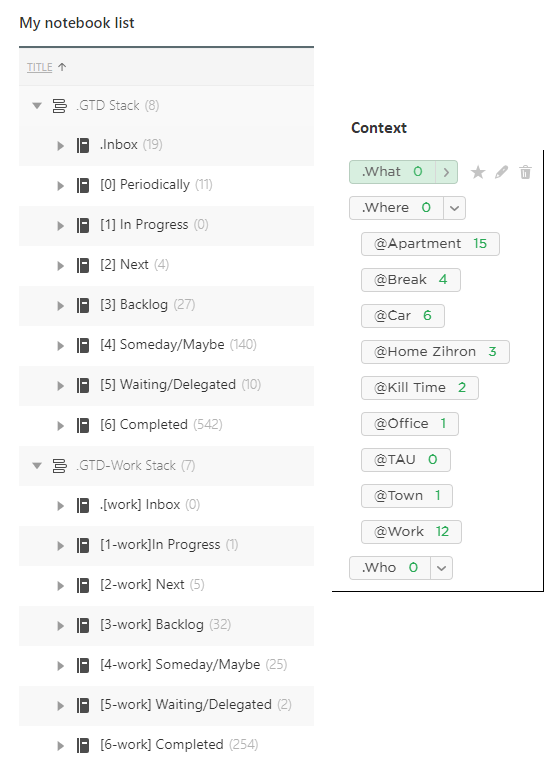
Below is a screenshot of my own setup which has worked for me for years. Note the separation of work and life into two notebook stacks. Task status switches are very easy to manage.
My Evernote GTD implementation. Left: task status as notebooks. Right: context as nested tags.
Pros
Super easy to capture tasks, ideas and information. Evernote implemented a great capturing tool on android by creating a 1-click widget to capture text, photos or voice. Everything goes into the inbox to be processed later.
Extremely flexible. Using notebooks and tags you can set up your system any way that you want. Tags have infinite hierarchy.
Cons
Not GTD-native. By that I mean that while Evernote is versatile enough to implement GTD, it wasn’t built with GTD first in mind. The result is a somewhat clunky daily experience. For example:
Tasks are just Evernote notes, which don’t have standard task properties like energy levels, time estimation or the ability to “tick” a box when done in a satisfying manner.
Reminders in Evernote are weak and it is hard to define and properly follow self-imposed due dates.
Two GTD notebook stacks are required to separate work and life tasks. Or at least that’s the best separation I could think of.
Todoist
A well designed and implemented general task-management app. Requires a lot of tinkering to fit to the GTD system and then it’s a proper solution. I love how responsive and intuitive the app is and that it has many third party integrations. In my opinion even after proper setup it’s second to NiravanaHQ, but for non-GTD-purists it might be a winner.
Implementation
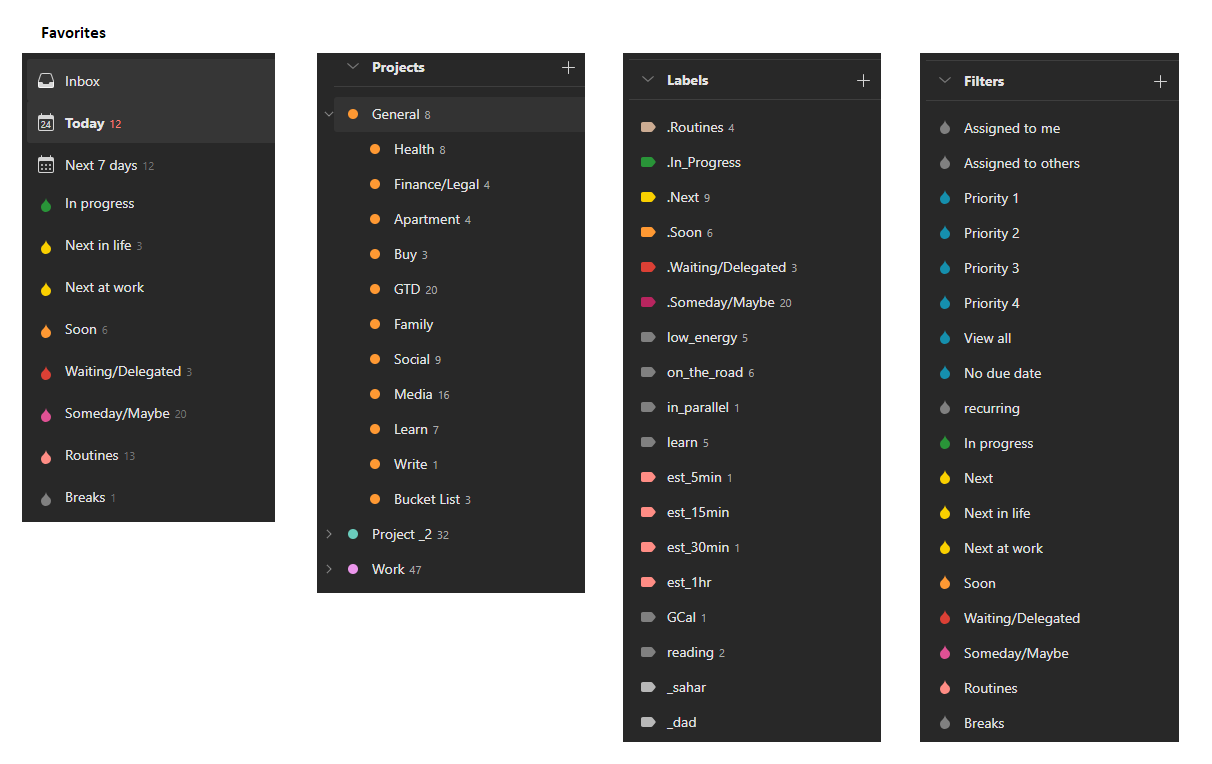
The setup in one picture:
My Todoist GTD implementation. Left to right: Favorites, Projects, Labels, Filters.
The main problem with implementing GTD on Todoist is that this software is oriented around due dates and there is no clear way to implement task status. This could be solved by either having a set of mutually exclusive labels (for task status) or simply nested labels (for projects, which would free up the Todoist projects pane for task status purposes). Unfortunately both features are missing, so I’m facing a dilemma:
If I use the projects tab for task status, then I have to implement my actual projects as labels, which sucks because Todoist labels are not nested and generally not first class citizens.
If I use labels for task status, they are not mutually exclusive which is one of the two requirements above.
How to solve this? Interestingly, I found a way around this limitation with the use of filters: give each task-status a label.
For each task-status create a filter which shows only tasks for which that status is the highest priority.
Add the filters to favorites and then view the task statuses from there.
As an example, say I have the task “buy milk”.
At first I add the label Soon to it. Then at some point the task becomes relevant and I add the label Next to it. The filter for Next is set up in such a way that it shows everything with label Next, so the task will be seen under it. But! The filter for Soon is set up so that tasks which belong also to Next do not appear under it, and so the task is effectively gone from this view.
To define the filter simply enter: Soon & !Next which translates to: “Show me tasks which belong to Soon and don’t belong to Next”.
Naturally I setup the other task-status the same way.
Pros
Full of integrations with other services
A very smooth experience both on web and mobile
Powerful reminders and repeating tasks
Cons
Not GTD-native and not trivial to set up proper GTD even when trying. And to be honest, even after proper set up I was still missing some critical GTD features like assigning a contact person to a task (it’s possible to implement contacts as labels, but since there are is no nesting with Todoist labels it becomes a mess).
I don’t really get the purpose of the karma system (scores your productivity).
NirvanaHQ [winner]
Nirvana Finds a great balance between true GTD implementation and a light, well designed modern service for web and mobile. It’s not perfect (I am sorely missing integrations with outside services such as calendar or IFTTT/Zapier and support for task images / attachments), but it really achieves the GTD vision simply and beautifully. My current choice.
Pros
GTD-native. Easy to manipulate and process the tasks.
Intuitive UX and a smooth experience across web and mobile.
Using Areas, very easy to separate work and life tasks.
Overall, strikes a great balance between GTD purity and great UX.
Cons
No integrations with other services such as calendar.
No support for attachments of any kind. This service is only text-based for now.
Repeating tasks do not support countdown from the time your finished the previous iteration of the task.
Task capturing on mobile is weak (requires opening the app and then a long press on “+”). This is solved by adding an IFTTT note widget which sends an email to my Nirvana inbox.
Note:
I was recently made aware that there is an offline-desktop clone of NirvanaHQ, called Everdo. After testing it for a few minutes, it is a near-perfect clone, down to exact UI placements. Personally I don’t like such blatent copying, but for some of you this might be an alternative to consider.
FacileThings
The truest, most hard-core implementation of GTD I’ve seen. It is the only tool that has built in consideration of your purpose, vision, goals, areas of responsibility and it even formalized the weekly review process. Too bad the UX is not so well designed and requires a lot of clicks to get anything done, and perhaps a bit too restrictive in doing GTD “the right way”.
One thing I’ve noticed about FacileThings is that it’s a great platform for introducing people to the GTD method. Some of my friends who were not that interested in reading the book were happy to just watch a youtube summary of it and then try FacileThings, which provided a guided, handheld GTD experience. As their free trial ended, some of these friends decided to continue with GTD, but not all of them stayed with FacileThings.
Pros
A great, very true implementation of GTD. I’ve actually recommended this service to friends as an introduction to the method instead of the book - it’s more interactive and forces you to work right.
The only implementation I’ve seen that incorporates higher GTD concepts such as the weekly review, areas of responsibility, Vision, life goals, etc.
Cons
Clunky UX. It’s too hard to manipulate tasks and get all their parameters right.
Mobile experience is not good.
Not flexible. You can’t do shortcuts that are against the pure GTD way. For example:
you can’t add a task to the inbox and immediately process it. It goes into a processing queue which means that I only get to fill out the details when I’ve already left the current context.
Other GTD apps
Since posting, additional GTD apps have been recommended to me by various readers of this post. I’ll try to keep a list of them here:
Nozbe
Everdo
GTDNext
Skedpal
(Update 2019-11-04) Amazing Marvin - this one looks amazing. Extremely configurable and serious power under the hood.
I’ve given each of these at least a cursory glance and while some of them are quite nice, my overall recommendations remain the same.
Further discussion
Feel free to join the discussion about this post in the official GTD forums and on Reddit.
Alternatively, you can leave a comment below.
]]>{"name"=>nil, "picture"=>nil, "email"=>nil, "twitter"=>nil, "links"=>[{"title"=>nil, "url"=>nil, "icon"=>nil}]}Inadequate Equilibria - Where and How Civilizations Get Stuck [messy book summary]2017-06-01T00:00:00+00:002017-06-01T00:00:00+00:00https://eddiesmo.github.io//inadequate-equilibria-where-and-how-civilizations-get-stuck-book-review
“If you want to outperform—if you want to do anything not usually done—then you’ll need to conceptually divide our civilization into areas of lower and greater competency. My view is that this is best done from a framework of incentives and the equilibria of those incentives […]”
Eliezer Yudkowsky has a talent for teaching rationality, economics and decision theory concepts in an accessible manner and usually his writing helps transform unformed thoughts into proper labels and names, thus enabling new modes of thinking.
Below are the concepts I’ve taken from this book (might be hard to understand without reading the book):
Efficiency, inexploitability, inadequacy
Efficiency [as in, efficient market]:
“Microsoft’s stock price is neither too low nor too high, relative to anything you can possibly know about Microsoft’s stock price.”
Inexploitability [There is an inefficiency but we can’t make money off of it]: “Some houses and housing markets are overpriced, but you can’t make a profit by short-selling them, and you’re unlikely to find any substantially underpriced houses—the market as a whole isn’t rational, but it contains participants who have money and understand housing markets as well as you do."
Inadequacy [a gap where you can outperform the best current human results]:
“Okay, the medical sector is a wildly crazy place where different interventions have orders-of-magnitude differences in cost-effectiveness, but at least there’s no well-known but unused way to save ten thousand lives for just ten dollars each, right? Somebody would have picked up on it! Right?!"
– Modest epistemology [the point of view Eliezer is refuting in this book]: If there’s really something to improve/discover here, someone would’ve already done it! I’m not smarter/better than others so why assume that I know or can do something other don’t?
Moloch’s Toolbox
There’s a toolbox of reusable concepts for analyzing systems I would call “inadequate”—the causes of civilizational failure, some of which correspond to local opportunities to do better yourself. I shall, somewhat arbitrarily, sort these concepts into three larger categories:
Decisionmakers who are not beneficiaries;
Asymmetric information;
and above all, Nash equilibria that aren’t even the best Nash equilibrium, let alone Pareto-optimal.
In other words:
Cases where the decision lies in the hands of people who would gain little personally, or lose out personally, if they did what was necessary to help someone else;
Cases where decision-makers can’t reliably learn the information they need to make decisions, even though someone else has that information; and
Systems that are broken in multiple places so that no one actor can make them better, even though, in principle, some magically coordinated action could move to a new stable state.
After introducing the basic concepts of inadequacy analysis, Eliezer goes into some case studies, sometimes in depth. He starts with the U.S. medical system (“the most broken system that still works”) but then also dissected the failures and inadequacies of Academia, venture capitalism and politics.
As examples of personal contributions in instances where our civilization happens to be inadequate, he cites finding a solution for his wife’s psychological problem which involved installing 65 light bulbs in their house, creating his own ketogenic meal replacement drink recipe, inventing a new decision theory and knowing that the bank of Japan’s monetary policy was harming Japan’s economy.
Overall Eliezer’s writing is as clear and entertaining as ever and it’s obvious he is learning from previous publications such as Rationality: A to Z. He is giving many concrete examples for his abstract writing with practical suggestions on how to use and not misuse the techniques presented. The book is much shorter than previous ones but still too long and could use further editing, especially the last third. Overall, if you’ve ever enjoyed Yudkowsky don’t skip this one.
Finally, some quotes that I thought were worth highlighting:
For our central example, we’ll be using the United States medical system, which is, so far as I know, the most broken system that still works ever recorded in human history. If you were reading about something in 19th-century France which was as broken as US healthcare, you wouldn’t expect to find that it went on working when overloaded with a sufficiently vast amount of money. You would expect it to just not work at all.
In previous years, I would use the case of central-line infections as my go-to example of medical inadequacy. Central-line infections, in the US alone, killed 60,000 patients per year, and infected an additional 200,000 patients at an average treatment cost of $50,000/patient….
So my new example is infants suffering liver damage, brain damage, and death in a way that’s even easier to solve, by changing the lipid distribution of parenteral nutrition to match the proportions in breast milk.
To paraphrase a commenter on Slate Star Codex: suppose that there’s a magical tower that only people with IQs of at least 100 and some amount of conscientiousness can enter, and this magical tower slices four years off your lifespan. The natural next thing that happens is that employers start to prefer prospective employees who have proved they can enter the tower, and employers offer these employees higher salaries, or even make entering the tower a condition of being employed at all.
Visitor: Hold on, I think my cultural translator is broken. You used that word “doctor” and my translator spit out a long sequence of words for Examiner plus Diagnostician plus Treatment Planner plus Surgeon plus Outcome Evaluator plus Student Trainer plus Business Manager. Maybe it’s stuck and spitting out the names of all the professions associated with medicine.
CECIE: Your translator wasn’t broken. In our world, “doctors” are supposed to examine patients for symptoms, diagnose especially complicated or obscure ailments using their encyclopedic knowledge and their keen grasp of Bayesian inference, plan the patient’s treatment by weighing the costs and benefits of the latest treatments, execute the treatments using their keen dexterity and reliable stamina, evaluate for themselves how well that went, train students to do it too, and in many cases, also oversee the small business that bills the patients and markets itself. So “doctors” have to be selected for all of those talents simultaneously, and then split their training, experience, and attention between them.
VISITOR: I must still be missing something. I just don’t understand why all of the people with economics training on your planet can’t go off by themselves and establish their own hospitals. Do you literally have people occupying every square mile of land?…
VISITOR: So there’s no way for your planet to try different ways of doing things, anywhere. You literally cannot run experiments about things like this.
The observation stands: there must be, in fact, literally nobody on Earth who can read Wikipedia entries and understand that omega-6 and omega-3 fats are different micronutrients, who also cares and maximizes and can head up new projects, who thinks that saving a few hundred babies per year from death and permanent brain damage is the most important thing they could do with their lives.
Living in an Inadequate World:
Whether you’re trying to move past modesty or overcome the Free Energy Fallacy: Step one is to realize that here is a place to build an explicit domain theory—to want to understand the meta-principles of free energy, the principles of Moloch’s toolbox and the converse principles that imply real efficiency, and build up a model of how they apply to various parts of the world. Step two is to adjust your mind’s exploitability detectors until they’re not always answering, “You couldn’t possibly exploit this domain, foolish mortal,” or, “Why trust those hedge-fund managers to price stocks correctly when they have such poor incentives?” And then you can move on to step three: the fine-tuning against reality.
So a realistic lifetime of trying to adapt yourself to a broken civilization looks like:
0-2 lifetime instances of answering “Yes” to “Can I substantially improve on my civilization’s current knowledge if I put years into the attempt?” A few people, but not many, will answer “Yes” to enough instances of this question to count on the fingers of both hands. Moving on to your toes indicates that you are a crackpot.
Once per year or thereabouts, an answer of “Yes” to “Can I generate a synthesis of existing correct contrarianism which will beat my current civilization’s next-best alternative, for just myself (i.e., without trying to solve the further problems of widespread adoption), after a few weeks’ research and a bunch of testing and occasionally asking for help?” (See my experiments with ketogenic diets and SAD treatment; also what you would do to generate or judge a startup idea that wasn’t based on a hard science problem.)
Many cases of trying to pick a previously existing side in a running dispute between experts, if you think that you can follow the object-level arguments reasonably well and there are strong meta-level cues that you can identify.
The accumulation of many judgments of the latter kind is where you get the fuel for many small day-to-day decisions (e.g., about what to eat), and much of your ability to do larger things (like solving a medical problem after going through the medical system has proved fruitless, or executing well on a startup).
Oh, and bet. Bet on everything. Bet real money. It helps a lot with learning.
]]>{"name"=>nil, "picture"=>nil, "email"=>nil, "twitter"=>nil, "links"=>[{"title"=>nil, "url"=>nil, "icon"=>nil}]}The Pondered Life - Setting the Quest2015-11-18T00:00:00+00:002015-11-18T00:00:00+00:00https://eddiesmo.github.io//the-pondered-life-setting-the-quest
“The unexamined life is not worth living.”
– Socrates
It is a universal trait, I believe, to reflect and evaluate. We strive to do so in our jobs, in our schools, and at least once a year on holidays. But do we do it enough where it really counts? Do we examine the big, important things? It is my observation that most of us lose sight of the forest for the trees.
Our society obliquely dispirits self-awareness with a weekly cycle of obligations and consumerism. In the age of never-ending work and entertainment there is hardly any time left for slowing down, for self-reflection, for sitting alone and thinking.
Why do we do what we do? What are our principles and values and are we adhering to them? How do we choose our goals and aspirations? Are we leading the life we want to lead?
These questions are profound and a tad dramatic. It is my interpretation of Socrates that at least striving to find personal answers should be of the highest priority to anyone seeking to live a life with some sense of shape or direction. It is not necessary (or possible?) to arrive at polished theories on each of these, but it is important to give them some thought and keep them in mind as we build our lives.
What do we stand to gain by this, exactly?
The unconsidered life is without thought or direction. It is heavily dependent on chance, on other people’s choices, on society’s norms. You experience it, but is it truly yours in the sense that you can do whatever you want with it?
I picture a man in a boat, without a map. He doesn’t know where he is, nor where he is going. He is lost, aimless, and will arrive wherever the current takes him. Should fortune smile upon him, his ride will be enjoyable and his destination worthwhile. However, it could just as easily not be the case and he, in fact, lacks the tools to even make the distinction.
“Alice: Which way should I go?
Cat: That depends on where you are going.
Alice: I don’t know.
Cat: Then it doesn’t matter which way you go.”
― Lewis Carroll, Alice in Wonderland
Pondering life is creating a map to it. It doesn’t have to be very precise, but an improved grasp of the surrounding world and our own inner workings instills a better sense of the desirable places to visit and how to get there. The effects of the current would still be felt, but armed with the insight and the tools for steering, we gain a measure of control over our own destiny.
Is the considered life better than its counterpart?
One thing that I cannot say is that this is the sure way to happiness. Ignorance can be bliss indeed. For some, it is easy and convenient to get carried along by the current, let it lead them anywhere and blame it for both fortune and misfortune, or adopt a passive “such is life” stance and enjoy the ride whatever it is. For others, closing their eyes to the possibilities slowly engenders a vague sense of dissatisfaction.
“You take the blue pill, the story ends. You wake up in your bed and believe whatever you want to believe. You take the red pill, you stay in wonderland, and I show you how deep the rabbit hole goes.“
― Morpheus, to Neo, The Matrix
Those who have observed people dying, often witnessed a more thorough examination of life than is typical. It seems that when the clock is running out, the noise of daily life finally dissipates enough for some honest self-reflection. It is debatable whether said reflection is objective at this stage, due to distortions in memory and other psychological and logical biases, but some regrets are unsurprisingly common:
“I regret not living a life more true to myself.”
“I regret working too hard, not having the courage to express my feelings, not staying in touch with my friends…”
Some of these seem awfully easy to fix, don’t they?
This begs the question of whether the same conscious, contemplative process couldn’t have been employed earlier, leading to a more fulfilled life, which in turn could result in a more content death.
“Most people would sooner die than think; in fact, they do so.”
– Berrand Russel
Luckily, we don’t have to choose between thinking and death. We just have to set aside time in our daily routine to ask some of the truly important questions, and think, really think whether our actions and decisions correspond to the answers. We are not alone in this endeavor; Intrinsic to the internet, we have access to the inclusive, ongoing conversation of humanity at our fingertips. There is more than enough to read, learn and explore. The quest is set.
Let’s embark on this journey together. Let’s draw a map!
]]>{"name"=>nil, "picture"=>nil, "email"=>nil, "twitter"=>nil, "links"=>[{"title"=>nil, "url"=>nil, "icon"=>nil}]}Harry Potter and the Methods of Rationality [book review]2012-02-18T00:00:00+00:002012-02-18T00:00:00+00:00https://eddiesmo.github.io//Harry-Potter-and-the-Methods-of-Rationality-book-reviewAI researcher and decision theorist Eliezer Yudkowsky probably woke up one day and asked himself a single question: what would have happened in Harry Potter’s first year in Hogwarts, had he not been such an insufferable idiot?
You might not have considered him to be an idiot in the first place, but as the book progresses and the new Harry makes his way around Hogwarts, facing the same problems and situations, it becomes impossible to ignore the oh so logical and natural way he handles them this time. It really makes one wonder what was going through his head in the original version and feels like a direct critique of Rowling. It made me wonder how I managed to ever take the original seriously (might have something to do with me being 8 at the time).
In Eliezer’s version of the story, Harry is a child prodigy; Highly intelligent and educated well beyond his years in the sciences and the methods of rationality, he is well equipped to handle anything the magical world can throw at him and then some. But this Harry also has a dark side and we get to know him better as he struggles to find balance in himself.
The differences in this parallel universe don’t end with Harry, though. His adopting parents, Petunia and Prof. Michael Verres-Evans, are happily married and treat him as they would their own flesh and blood. Ron and Hermione remain mostly the same, although genius Harry obviously prefers to interact with the hard working book-worm and quickly decides that a boring, average ginger is simply not worth his precious time (speaking of time… no, I won’t ruin the surprise). A cunning and manipulative Draco Malfoy and a powerful yet cynical Prof. Quirrell take on larger roles, in quite unexpected ways. We also see much more of Dumbledore (who’s actually read The Lord of the Rings, seeing as every muggle student ever to come to Hogwarts thought that gifting him a copy was an original idea).
It seems important to note that magic is also treated a little bit differently, especially by a scientific Harry, who sets out to test and understand it, thus restoring order to the seemingly shattered laws of physics. Naturally, things don’t go according to plan and at times he is forced to improvise.
The book started out pretty well, with some laugh out loud scenes as Harry finds out about magic for the first time (see quote below). As I read the first few chapters I kept waiting for the level to drop, for the premise to exhaust itself, for my enthusiasm to subside, but 300 pages in and hungrily reading on, It was clear that I’ve stumbled upon something great and that the story is safe in the deft hands of Eliezer Yudkowsky.
“You turned into a cat! A SMALL cat! You violated Conservation of Energy! That’s not just an arbitrary rule, it’s implied by the form of the quantum Hamiltonian! Rejecting it destroys unitarity and then you get FTL signaling! And cats are COMPLICATED! A human mind can’t just visualize a whole cat’s anatomy and, and all the cat biochemistry, and what about the neurology? How can you go on thinking using a cat-sized brain?”
– Harry, HPMoR
The book is funny, at times hilarious. The premise is well executed as Eliezer draws from his vast experience as a rationalist and lets us take a look at genius minds at work; we all know how hard that is to pull off. Methods of Rationality really hits its stride around chapter 5 and according to the author if you haven’t taken to it by chapter 10, then that’s a good time to call it quits (and rethink your interests).
From the get-go, different decisions create chains of cause and effect that send the book in pretty different directions (like Harry finding out almost immediately that he’s prophesied to battle against the dark lord). Other scenes repeat almost word for word, like the first potions lesson with Snape (only this time, Harry refuses to play the victim and stands up to him, in a rather spectacular fashion).
As the story progressed, I found myself engrossed in the plot, invested in the characters and generally unable to put the book down. It is not flawless and at times Eliezer’s inexperience as a novel writer shows, but overall this is as good as it gets. Come for the premise, stay for the story and along the way let the message of rationality rub off and enlighten you. I’ve rarely been as inspired to study, as in love with science or as driven to succeed as when I’ve read this book.
[Posted on goodreads in 2012 by a younger, very impressionable Eddie. Still one of the most influential books I’ve read and the one that started me on the
Rationality path.]